How to Reward Community Ambassadors Without Paying Them: A Reward Ladder Built on Access
Small cash rewards put a low price on your most committed members' work. Access to your team, access to each other, named credit and personal attention cost less and last longer, as long as you run them as a system.
The habit, and the reason behind it
Ambassadors are the vetted volunteers who carry a large share of a community's work. They host events, moderate, publish content, welcome newcomers and run user groups in their own cities. When programs look for a way to thank them, many settle on small payments, such as a voucher for joining a feedback session or a gift card for completing a research form.
The appeal is practical. Small payments slot into an existing budget line, so nobody has to argue for them. They are easy to report on. They feel even-handed, since time goes in and something comes back. They also suit the situation they were built for, which is asking a stranger for a short, one-time favour.
Applied to committed members, the same habit backfires, and the fix is well defined.
Four ways the payment works against you
- It sets a low rate on their time. Someone who has hosted an event every month for a year has given you a great deal. A voucher puts a number on that, and many ambassadors earn well above it in their day jobs. They notice the gap.
- It changes why they show up. Volunteers contribute because they care about the product and the people. Introduce a fee and some of the motivation shifts onto the fee. Paid work gets weighed against its payment, and when the budget for that payment disappears, contributions often follow it out.
- It shows them they are interchangeable. The same reward sent to everyone tells people the team sees a list rather than individuals. Your strongest contributors pick up on it quickly. Some find it insulting, though very few will tell you.
- It gives your staff a way around the relationship. A survey with a voucher attached lets a product team gather opinions without ever talking to anyone. Ambassadors signed up for the conversation.
None of these costs show up in a report. They show up a year later as ambassadors who quietly decline to renew, and by then the cause is hard to trace.
What they tell you they want
Ambassadors are unusually clear about what they value, and it is almost all access:
- Direct time with the people building the product
- A real role in shaping it, with visible proof when their input lands
- A space only ambassadors can see, where peers swap ideas and help each other
- Small gatherings of top contributors, in person where possible
- AMA sessions, short for "ask me anything", where product owners take questions live
- Surprises that show someone was paying attention
- Being remembered: how they like to help, when they joined, what they last asked for
Of all of these, the private peer space is the one they tend to protect hardest. Ask which single perk they would keep and it usually comes out on top. It is inexpensive to run, and its value rises with each new member, since every addition gives existing ambassadors another peer to learn from.
Building the ladder
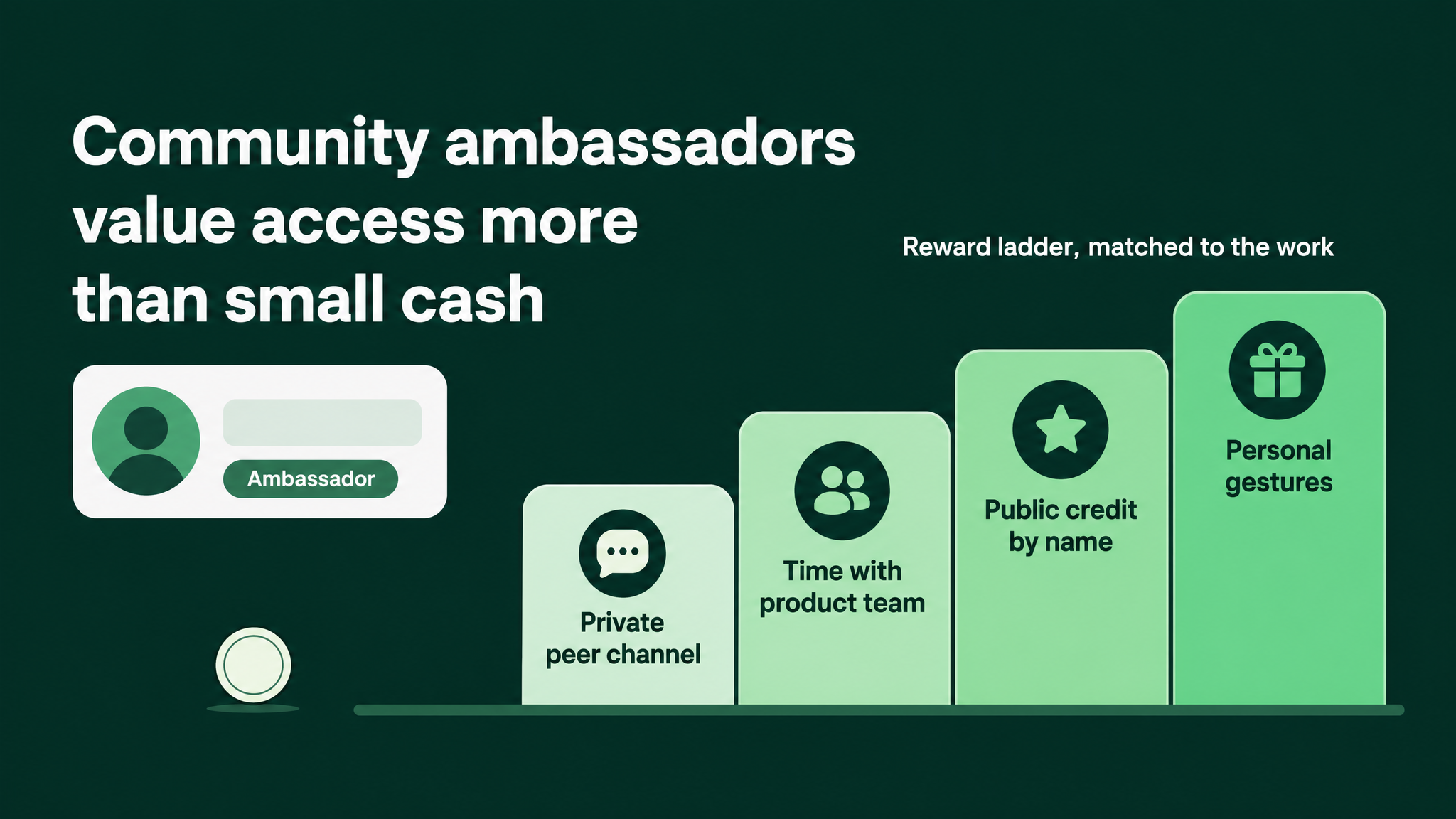
Arrange non-cash rewards into four rungs. Each step up requires more knowledge of the individual, and fewer people reach it, which keeps the higher rungs special. Rungs accumulate, so someone on rung three keeps everything below it.
Rung 1, peer access. For every ambassador from their first day. A private ambassador channel, small group virtual sessions, and introductions to others doing similar work.
Rung 2, product access. For anyone who contributed feedback or content during the quarter. Early builds, previews of the roadmap, a named contact on the product team, and a seat at AMAs.
Rung 3, recognition. For a specific contribution you can name. A spotlight post, credit in the release notes, or promotion to a higher role such as Senior Ambassador, marked with its own Discord role badge.
Rung 4, personal gestures. For the small group doing the most. Chosen from their profile: a handwritten note, a gift tied to something they mentioned, a marked program anniversary, or an invitation to an in-person gathering.
A useful test for rung four: could this gesture have gone to anyone else? A book by an author they talked about passes. A thank-you recorded by the engineer who built their requested feature passes. Generic store credit fails, whatever its size.
Choosing the right reward for the work
The ladder sets how much. Matching sets which one, and the principle is to reward people in the currency of their contribution.
- Organisers of events and user groups want to meet other organisers and be seen as leaders. Offer a place at the quarterly host session, a spotlight after each event, and first pick of speakers from your team.
- Moderators want trust and a say. Offer early input on rule changes, a senior moderator role, and a direct line to the community lead.
- Content creators want reach. Feature their work on your official channels under their name, and give them early access so they can publish first.
- Feedback givers want to see impact. Credit them by name when their idea ships, and set up time with the product manager who owns that area.
- People who answer newcomers want to be known as experts. Give them an expert role badge and mention them in the monthly recognition post.
A monthly routine keeps this consistent:
1. Note what each contributing ambassador did this month
2. Read their "last asked for" field
3. Pick a reward in the same currency as their work
4. If it repeats last month's reward, choose a different option on that rung
5. Record the reward and the date
The repeat check in step four is the one teams skip, and it is the one that stops rewards from feeling automatic.
Keeping a profile on each ambassador
Good matching depends on knowing people, and knowing people at any scale depends on writing it down. Keep a contributor profile for each ambassador. A shared spreadsheet works for smaller programs, and a customer database works if your company already has one, which also protects the knowledge when team members change roles.
CONTRIBUTOR PROFILE

Name / Discord handle:
Program role and join date:
Preferred contribution:      events | moderation | content | feedback | helping newcomers
Thanks style:                public | private
Milestones:                  first event hosted, first feedback shipped, program anniversary,
                             birthday (only if shared)
Last asked for (and date):
Feedback given and status:   open | planned | shipped | declined
Last reward (and date):
Notes from last conversation:
Keep only what members have told you or would expect you to know, and ask before recording anything personal. Let ambassadors know the profile exists. Being remembered feels good. Being tracked without knowing feels uncomfortable, and openness is what separates the two.
Putting it on a calendar
Anything that relies on memory eventually slips. Fix the rhythm in advance.
| How often | What happens |
|---|---|
| Weekly | Log contributions into profiles, roughly half an hour for a few dozen ambassadors |
| Monthly | One recognition post naming two to four people for specific work, plus one AMA with a product team |
| Quarterly | A focused small group session for top contributors, and a profile review to catch anyone going quiet |
| Twice a year | A program survey asking which one perk each ambassador would keep |
| Each release | Close the loop on every shipped piece of feedback |
Crediting feedback that shipped
Closing the loop is the practice of telling a member, personally, that their suggestion is now in the product. It costs almost nothing and ranks among the most valued rewards available, since it confirms what ambassadors care about most: that their effort makes a difference.
The process runs in four moves. Record the member's name against every piece of feedback the moment it is logged. When the change goes live, message them directly before any public announcement. If they agree, name them in the release post. Then update the feedback status in their profile to shipped.
Example message: "The change you asked for in March, letting moderators pin threads from mobile, went live today. Your write-up is what moved it up the list. Can we thank you by name in the release notes?"
Feedback that will not ship needs a reply too. Commit to a fixed window, thirty days works well, within which every ambassador learns what became of their suggestion, with a plain reason if it was declined. No answer feels like being ignored. A clear no with a reason feels like being taken seriously.
Where payment still belongs
Some work should be paid, and paying for it is the respectful choice.
- Transactions with outsiders. One-off research with non-members, usability testing with first-time users, and any favour from someone with no stake in your community.
- Work that is really a job. When an ambassador agrees to build a full course, translate documentation or present at your conference as an expert, pay them properly, at a real rate, under a written agreement.
What this system replaces is the middle ground: small token sums handed to insiders for things they would have done regardless.
Signs a reward has gone stale
Rewards wear out. Look for these patterns around any single perk:
- AMAs draw the same few people and nobody new
- Recognition posts earn reactions but no replies from peers
- The private channel sits quiet for weeks
- Invitations to early access go unanswered
- Ambassadors ask what is coming next, a sign the current rewards no longer register
- A perk that used to be mentioned unprompted in the survey drops out of the answers
Two or more of these around one reward is enough to act on. Pause it for a quarter, ask a handful of ambassadors what they would prefer, and look at which rung of the ladder you have been neglecting.
The system around the rewards
Rewards are one component of a complete ambassador program. The others are selection and vetting, onboarding, contribution tracking, the private space, and off-boarding and renewal for members whose lives change. This piece gives you the reward layer in full, ready to set up without outside help. How well it performs depends on those neighbouring layers. Matching, for instance, is impossible without contribution tracking behind it.
Your most committed members have already decided the work is worth doing. The rewards you choose tell them whether you noticed. More at danieljeong.org.
Want a properly managed community?
Get Your Free Analysis →