How to Fix a Toxic Discord Community Without Mass Banning Your Most Active Members
Hostility in a community is usually a symptom of unpredictable enforcement and an unanswered complaint, and both of those are fixable without losing the people who still show up.
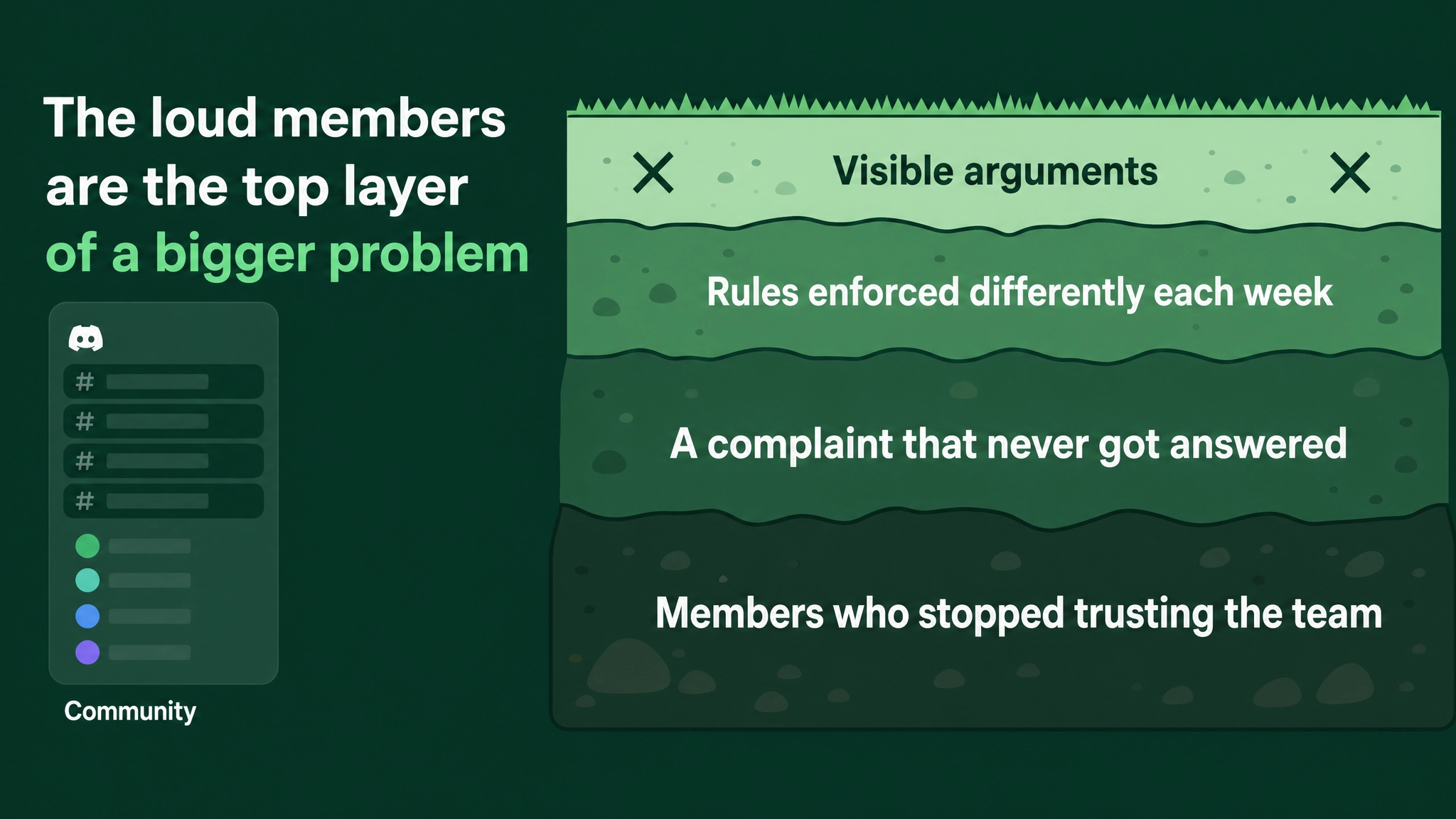
Why the ban wave fails
Remove the five loudest names and the room does go quiet. That is the problem, not the proof.
Everyone still present watched those removals happen and could not have predicted a single one of them. So they draw the reasonable conclusion and stop posting anything that carries an opinion. What you are left with after a month is a calm server with no conversation in it, and the next person who says something critical inherits the role you just cleared.
Removal assumes the participants are the cause. In most communities they are simply the visible layer, and underneath sit two conditions you control.
Condition one: enforcement that cannot be predicted
A sharp post about the product stays up on Monday. A milder one comes down on Friday. Nobody explains either decision.
From inside the team this never looks like inconsistency. It looks like judgment, and each individual call was defensible. One moderator was mid shift change. Another had context. A third read it as a joke.
From where the member stands, it is a rule that moves depending on who is online. What follows is reliable:
- They probe the boundary, because an invisible line has to be found by testing.
- Whoever eventually gets caught compares their case to one that was let through and concludes they were picked on.
- Everyone else watches that exchange and updates their view of what the rules are worth.
No bad actor is required anywhere in that sequence. Ordinary members become adversaries through nothing more than not knowing where they stand.
Condition two: a complaint that never got closed
Something specific happened and was never addressed where members could see it. A price move without explanation. A date that slipped in silence. An incident nobody acknowledged. A removal that looked like it was about the person.
Unanswered complaints do not fade, they migrate. They turn up inside threads about something else entirely, in the edge on ordinary questions, in what a veteran tells a newcomer about whether the team listens. The room keeps arguing it because nobody ever ended it.
Finding it takes an afternoon. Read thirty days of your busiest channels and tally what the arguments are genuinely about rather than what they are attached to. One complaint usually accounts for most of the heat.
Close the complaint, once, where everyone can see
Post it plainly in the channel people already use. Four parts:
What happened
What we got wrong
What changes
What does not change, and why
Teams consistently drop the fourth, and the fourth is what earns the credibility. A decision members dislike is survivable when it is stated honestly. Being handled around is not.
Afterwards, when it comes up again, link the post instead of re-arguing it. Reopening the debate signals that the first answer was a position rather than a decision.
Four rules, each with a fixed outcome
Not a conduct policy. Four lines a member can remember:
- Spam, scams and unapproved promotion.
Message removed, no warning - Personal attacks on another member.
24 hour mute, first time - Doing it again after a warning.
7 day mute - Sharing someone's private information.
Permanent removal
The count is the design. This list only does its job if a member can hold it in mind while typing, and nobody consults a nineteen clause document before posting. They consult what they saw happen to somebody else.
Note that each consequence is exact rather than a range. "Up to a permanent ban" hands back the unpredictability the whole exercise exists to remove.
Criticism of the product, the team or you is absent from the list on purpose. Moderating complaint produces a quiet room, and a dashboard cannot tell you the difference between quiet and well.
Fourteen days of identical enforcement
This is where it is won or lost, and it asks more of you than of the members.
Every one of the four rules is applied the same way, every time, for two weeks. When the person is a long standing regular. When their underlying point is correct. When acting is going to kill a thread you liked or irritate someone whose support you were counting on.
What gets rebuilt in that fortnight is predictability rather than tone. Members loosen up when they can see in advance what will happen to them, and a room full of people who are not bracing looks nothing like the one you are managing today.
Keep the moderator's role mechanical through the window. Identical phrasing on every action, a brief public note where it happened, and no argument about fairness in the channel itself. Nominate somewhere for that conversation and hold it after the action, not instead of it.
Then invite the quiet ones back
Most of the community stopped posting well before things turned unpleasant, and they are still reading.
Skip the broad reactivation announcement. In a room that has recently been hostile, a cheerful mass ping lands badly with precisely the people you are trying to reach. Do it individually instead: pick ten former regulars who have gone quiet for a month, write to each referencing something they actually contributed, ask something small and easy to answer, then give them a friendly public thread to reply in within the week.
Sequence matters more than effort here. Run this before enforcement is consistent and you are walking people back into the room they left.
Removal, last
A few people genuinely do have to go. After everything above, the list is short, and every name on it maps to a consequence you already published.
That mapping is the whole value. A removal matching a stated rule demonstrates the rules are real. A removal matching nothing demonstrates the team acts on mood, which returns you to the condition you set out to fix.
Reading whether it worked
Membership and message counts mislead here, since both rise while a community is fighting.
| Signal | What it tells you |
|---|---|
| Old grievance stops appearing in unrelated threads | The public answer actually closed it |
| Two moderators handle the same behavior identically | The rules are operating, not just published |
| Members answer each other before staff arrive | Trust in the room is returning |
| A criticism is posted and the thread stays civil | The real one, and the hardest to fake |
That last row is the measure worth holding onto. Health is not the absence of complaint. It is a complaint being made and handled in the open without the room going up.
The layer this belongs to
Enforcement consistency and moderation load form one layer of a community operating system, taught here fully enough that you can install it without anyone's help. Its neighbours are separate pieces of work: onboarding and the first forty eight hours, role and channel architecture, support routing, escalation paths, documentation, automation coverage, engagement rhythm, and leadership reporting.
Starting here is correct in almost every case, because every other layer you build rests on whether members believe the rules mean something.
A community rarely breaks because the wrong people walked in. It breaks when nobody can say what the rules are any more. Repairing that is slower and far less satisfying than a ban wave, which is precisely why it lasts. More at danieljeong.org.
Want a properly managed community?
Get Your Free Analysis →