How to Connect Members With Each Other in a Discord Community: A Weekly Introduction System
A before and after of one developer's first month, and the weekly introduction pass that turns a stranger with an unanswered question into a member who stays.
TL;DR
A first month, told twice
A developer joins on a Monday with one broken thing. Their company is connecting your webhooks to its billing system, and every few hours the signature check fails in production. They read the welcome message quickly and post the error in the help channel.
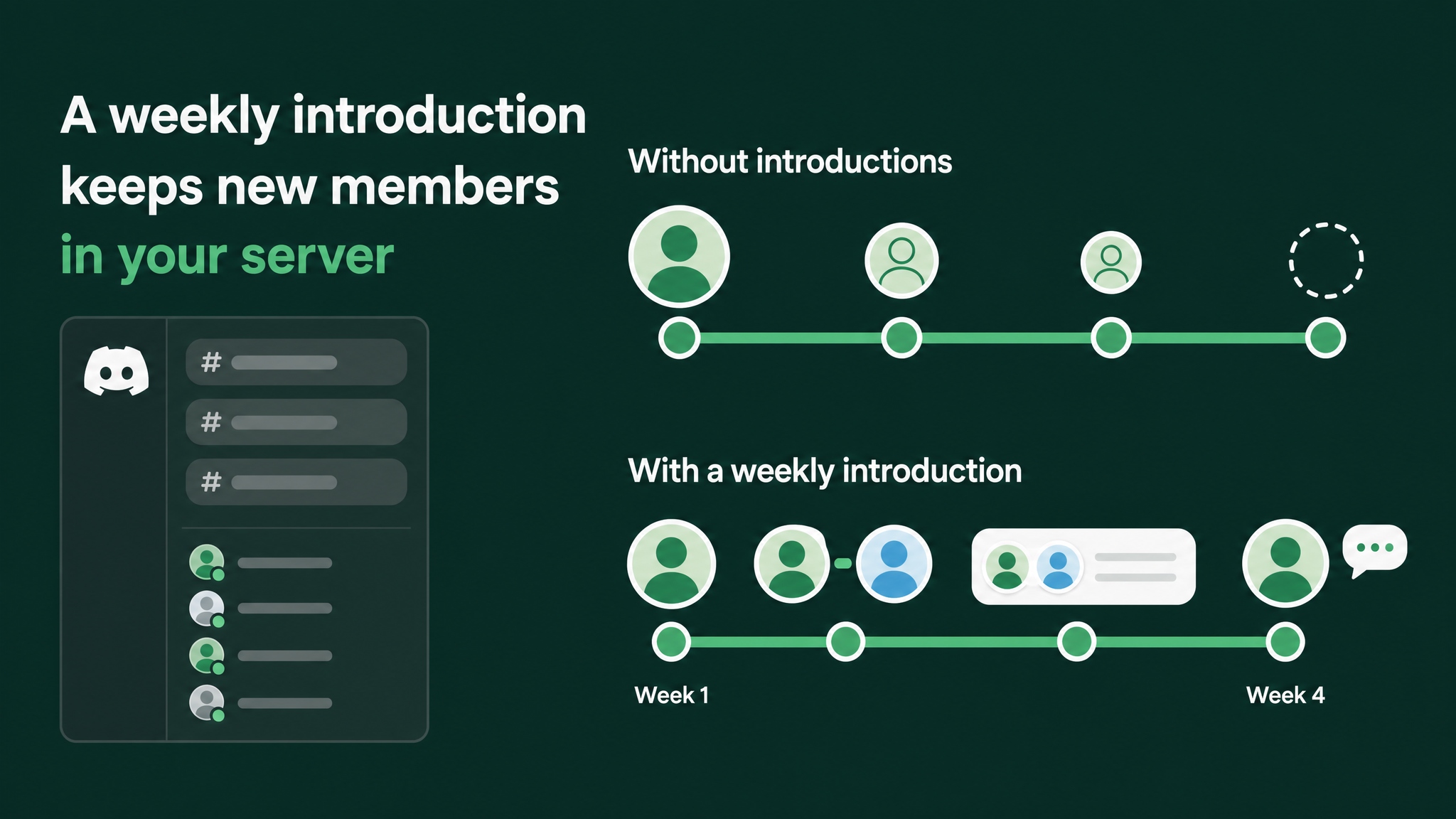
The first version of their month. The post collects one emoji reaction. Two days later someone asks for logs, and the developer has already switched to other work. In week two the question is buried, and they read a few threads without posting. In week three they open the server once and find nothing meant for them. By week four they have stopped coming, and no one on the team noticed, because no one knew they had arrived.
The second version. When they joined, they answered two short questions. Under what they are working on, they picked Webhooks. Under what they could help with, they picked Python SDK. That put a row in the team's sheet on day one. In week two, the weekly pass spotted a member who shipped the same integration last quarter and sits in the same time zone. The team asked both of them privately. Once both agreed, a private thread opened with a two line explanation of why they should talk. In week three they compared how each verifies signatures and found the cause, a clock setting on one server. Later they swapped notes in the help channel about retries. In week four the developer answered someone else's Python question, and the follow-up message confirmed the introduction had helped.
The product and the person were identical in both months. In the second one, someone on the team knew what this member needed and knew who already had it.
That is how connection between members happens reliably: a person makes it happen, on a schedule. Capture each member's need and offer at join. Hold them in a simple directory. Every week, choose a handful of pairs, ask each person privately, introduce each pair in a private thread with a concrete reason, and check back after seven days. Then count which introductions became repeat conversations. Everything below is that system in full, with the messages ready to copy.
Members rarely find their people in a busy general channel. They find them when someone on the team points them at each other and says why.
Why good members drift away
Left alone, member to member connection depends on luck. The general channel is supposed to handle it. What it actually does is favour people who are already known, while a newcomer's question scrolls past under everyone else's.
In a developer community the gap is wider, because a question is usually about something narrow, like one endpoint's rate limit or one SDK release. There is often exactly one member who can answer, and the odds of that person reading the help channel at the right minute are poor.
Discord will not make these matches for you, and neither will most community tools. The work falls to a person with a sheet and a weekly slot. At three to five introductions a week, that slot is about an hour.
The weekly introduction pass, in order
- At join, ask what each member is
working onand what theycan help with. - Keep their answers in a member directory. A spreadsheet works.
- Once a week, choose a handful of matches.
- Get a yes from both people before introducing them. This is double opt-in.
- Make the introduction in a private thread, with a specific reason.
- Check in with each person a week later.
- Record which introductions led to repeat conversations.
Asking the two join questions
Copy these as written:
What are you working on right now?What could you help another member with?
Put them in Discord's onboarding questions, the setup screens every new member passes through, configured from Server Settings. According to Discord's onboarding guide, each question is multiple choice and each answer can assign a role or reveal channels. So the answers become topic labels drawn from your product. A developer tool might offer Webhooks, Authentication, Python SDK, JavaScript SDK, Deployment and Data export. Six to eight options is plenty, with multiple answers switched on.
Give both questions the identical list. When a need and an offer share wording, they line up in the sheet with a single filter.
Topics alone lack detail. Add a short optional form, linked from the welcome message, with one free text field: In one sentence, what are you stuck on or building? Members who bother to fill it in are asking to be connected, so match them first.
State in the question text who will see the answers. Roles appear on member profiles, which makes any role based answer public. To keep offers private, gather can help with through the form only, and let only the team read it.
Building the member directory
Start a sheet with these columns. The header row and one sample row look like this:
Member, Joined, Working on, Can help with, Shared context, Open to intros, Last intro, Notes
@dev_river, (date), Webhook signature checks failing in production, Python SDK and retry logic, UTC+1 / Go and Python / two person startup, Yes, (date), Posted a good fix in the help channel- Member is who you will message.
- Joined lets you match the newest members first.
- Working on and Can help with hold the need and the offer, in the member's own words.
- Shared context is the extra detail that makes a match feel personal: time zone, language, company stage, the kind of project.
- Open to intros records consent as
Yes,Ask firstorNo, on every row. - Last intro keeps you from leaning on the same helper too often.
- Notes holds what you learn from their posts.
The same sheet prepares hosts for live events. Before a session, the host reads the rows of everyone who signed up and arrives knowing something about each of them.
Choosing matches each week
Keep one recurring slot. Filter the sheet to members from the last two weeks and anyone whose question never got an answer.
working on entry matches a can help with entry, and the two members also share one detail, such as a time zone, a language, a company stage or a type of project.The need and offer justify one conversation. The shared context is what makes a second conversation likely, and it shows the helper that the ask was made with them in mind.
Stop at three to five pairs. Past that, the messages begin to sound generated. Protect your helpers with two limits: no helper gets asked more than once in two weeks, and helpers should have at least a month in the server, so they know their way around.
The messages you send
Always ask the helper first, since they give the time. Message the new member only after the helper agrees. If either person declines, the other is never told they were considered. Each template below is ready to paste.
Asking the helper
Hey {helper}, a quick ask, and no is a fine answer.

A member who joined this week is working on {their need, in their words}. You mentioned you can help with {helper's offer}, and you're both {shared context}.

Would you be open to a short intro in a private thread? If yes, I'll set it up. If not, just say so and nobody else will know I asked.
Asking the new member, after the helper says yes
Hey {member}, you mentioned you're working on {need}. There's a member here who has {done the relevant thing} and is also {shared context}. They've said they're happy to help.

Want me to introduce you two in a private thread? Totally fine to say no.
The introduction, posted in the private thread
{member}, meet {helper}. {helper}, meet {member}.

Why you two: {member} is working on {specific need}. {helper} {specific relevant experience} {when}, and you're both {shared context}.

An easy first step: {member}, share where you're stuck in two or three lines. {helper}, reply whenever you have a minute. There's no deadline.

I'll check in next week. If this turns out not to be useful, either of you can leave the thread with no explanation needed.
The follow-up, sent to each person separately after seven days
Hey {name}, checking in on the intro with {other person}. Did you two get anything useful out of it?

Either answer helps. If it worked, I'll keep making intros like it. If it didn't, tell me what would have made it a better match.
Only the people added to a private thread can open it, plus moderators with permission to manage threads. Keep a dedicated channel for these threads, add both members by mentioning them, and title each one with both handles and the topic, such as @dev_river + @dev_sol: webhook signatures. Where private threads are not available on your server, a three person group DM works the same way.
Write the reason as something both people could reply to. A line like "You two should connect" leaves them with nothing to open with. A line like "You both hit signature failures on the billing webhook, and you fixed yours in March" gives them the opening. Stay in the thread to catch a stall, and otherwise keep quiet.
The follow-up replies double as feedback on your matching. Good topic fit with no conversation points to a weak shared context. Helpers who found the ask too large are telling you to narrow the need before you send the next one.
Measuring what the introductions did
Count these during each weekly pass:
| Stage | The question it answers | Where you see it |
|---|---|---|
| Proposed | Did the pass happen this week? | Your own asks sent |
| Accepted by both | Are the asks worth a yes? | Replies to the two opt-in messages |
| Both replied | Did the reason give them an opening line? | The private thread |
| Repeat conversation | Did a relationship form? | The pair talking again later in a public channel or a DM they mention |
| Active in week four | Are introduced members staying? | Posts from introduced new members during their fourth week |
Report repeat conversations every month, next to your normal activity numbers. A single useful thread fixes a problem. A pair who talk again without you have become part of each other's reason to show up.
Bot or person
A bot can post the weekly thread where members ask and offer. Deciding who to introduce stays with a person.
One piece benefits from a bot: a weekly ask and offer thread, posted automatically on a set day such as Monday morning. Members reply with a line beginning Asking: or Offering:. It lets members find each other in public, and it feeds your weekly pass a second list of possible matches.
Turn it on once the directory grows faster than one person can review in the weekly slot, or once members start requesting introductions themselves. Earlier than that, a mostly empty thread makes the server look quiet.
Choosing the match, the private asks, the introduction and the follow-up all stay with a person. Two strangers told by a bot that they should talk have no evidence anyone looked at either of them, and they usually ignore it.
Consent rules
- No member's details go to another member before that member says yes.
- Pass on only what the member wrote, in their words.
- The directory stays with the team. No screenshots of it anywhere.
- A no stands until the member changes it. Mark the row
Noand move on. - When a member leaves, delete their row.
Break any of these once and members start to wonder what else was shared. Keep all five and the system can run indefinitely.
The layer this belongs to
Introductions between members form one layer of a community's engagement rhythm and retention system. The neighbouring layers are onboarding, the first 48 hours after joining, weekly rituals, events, feedback loops, and reporting to leadership. This piece covers the introduction layer completely enough to launch unaided. The others are their own builds, and introductions land best when the first 48 hours already carry members far enough to answer the two join questions.
Most people who go quiet in their first month were waiting for someone to answer them. A single introduction gives them a name to return to in the server. More at danieljeong.org.
Want a properly managed community?
Get Your Free Analysis →