How to Audit a Competitor Discord Server Before You Build Your Own
A two hour walkthrough of three servers, joined as an ordinary member, with the same five measurements taken in each one. What to copy, what to ignore, and what the gaps tell you.
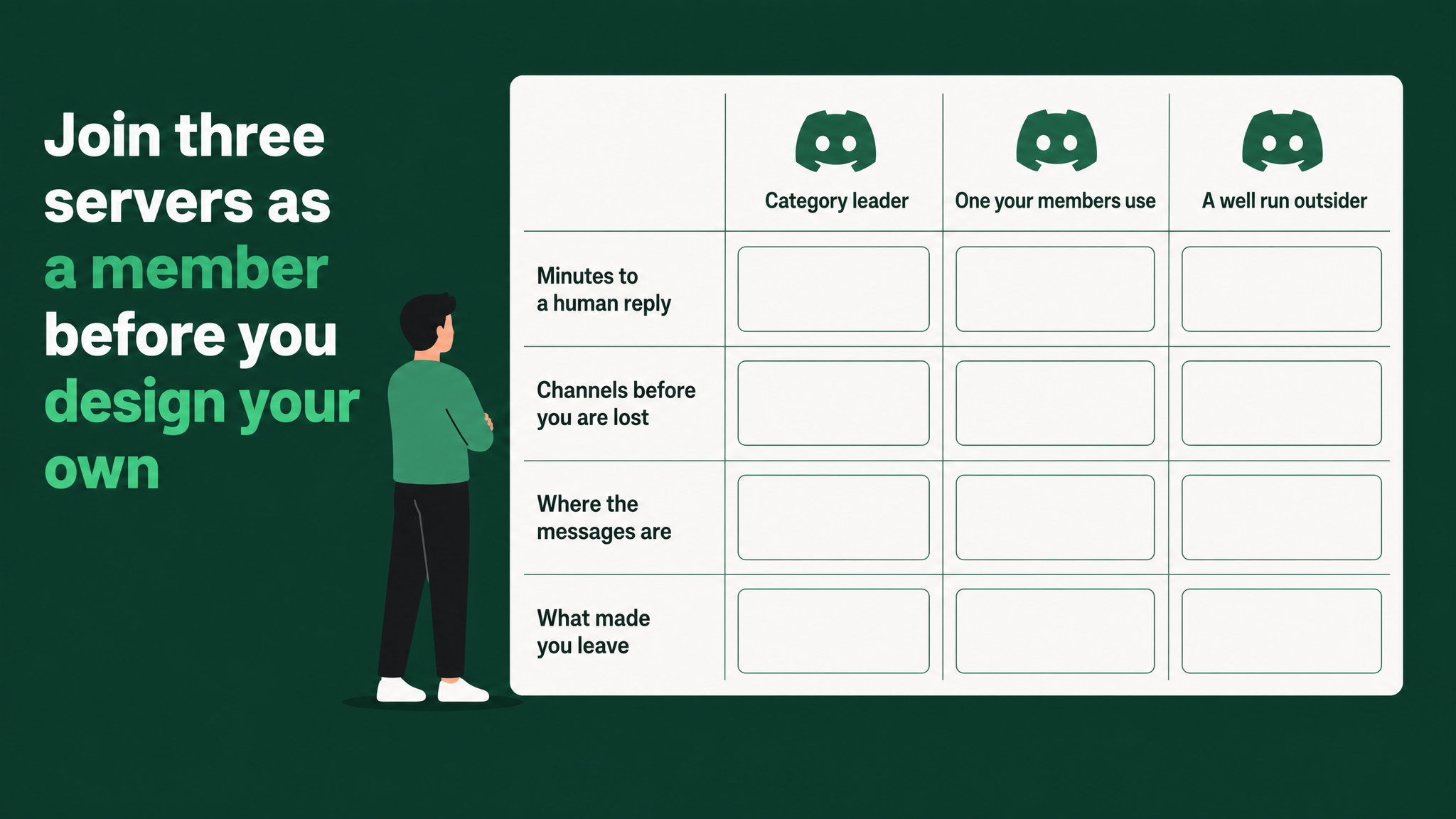
The two hours that replace a month of planning
Community plans are usually written in a document by people who have not recently been a new member anywhere.
The document lists channels, invents roles, proposes categories, and settles an argument about naming. None of it can answer the only question that matters, which is what it feels like to arrive in the room and try to get something out of it. That answer is available for free in any of a hundred existing servers.
The method below is fixed on purpose. A repeatable sequence produces three comparable results, and comparable results end arguments that opinion cannot.
Pick three, and make the third one strange
One: the biggest server in your category. This is the standard your members already have in their heads. Two: a server your own members spend time in, which is frequently not a competitor at all. Three: a well run server from a field with no connection to yours.
The third choice is the one teams skip and the one that produces every original idea in the exercise. Copying inside your category gets you a smaller version of the leader. Borrowing a mechanic from a field nobody in your space is watching gets you something that looks like invention.
Behave like a member for forty minutes
Go in through the front door and follow the instructions.
Complete the gate. Read the first channel in the order it asks. Take the roles offered. Do not open the member list, do not count channels, and do not screenshot anything for the first half hour. The instinct to evaluate is exactly what stops you noticing the confusion a real newcomer feels, and that confusion is the finding.
Anything you can learn from the outside of a server is the part that mattered least when it was built.
Ask one real question and follow it
Write a question you actually want answered, in the channel that looks right to you, in normal language.
Then track it. Who replied, staff or member. How long it took. Whether it was moved, ignored or buried under other messages. Whether you had to guess which room to use in the first place. One message tells you more about a community's support system than an hour of reading its channels, because support only exists at the moment somebody needs it.
The five measurements
Record them identically in all three servers. The value is in the comparison, not in any single figure, and a measurement taken differently in one server destroys the row it sits in.
Be specific about the fifth one. Not "it felt overwhelming" but "a role picker with thirty options before I could see a single message". Specific moments can be designed around. Feelings cannot.
Keep the mechanics, throw away the decoration
| What you saw | Copy it? |
|---|---|
| The order of events at the entrance | Yes, this is the mechanism |
| Where questions go and who answers them | Yes, this is the mechanism |
| How many channels are visible on day one | Yes, as a ceiling for your own |
| Emoji prefixes, naming style, banner art | No, this is decoration |
| Total channel count of a mature server | No, you would be copying years of accumulation |
A new server that borrows the surface of a large one reads as an imitation to anybody who has visited both, and that impression is expensive. Borrowing how the entrance works costs nothing and is invisible.
The most valuable line on the sheet is an absence
At the end of three visits, name the thing none of them did.
It is usually something plain. Nobody answered anything after Friday afternoon. Nobody gave a new member a first task. Nobody made previous answers findable, so the same question was being asked repeatedly in all three rooms. Nobody showed what members had achieved.
That absence is the only position available to you that is not already occupied, and it costs less to build than any attempt to match a larger server feature for feature.
Turn it into five decisions today
While it is fresh, write the first five channels a member will see in order, the answer path for one question including who responds and how quickly, the single action a member takes in their first minute, your version of the gap, and what you will do at the precise moment you wanted to leave the other servers.
Five written decisions, all evidence based, in one sitting. Most launch plans never reach that clarity.
The layers around this one
The audit is one layer of the build, and the cheapest of all of them to run.
Beside it sit channel and role architecture, onboarding and the first 48 hours, support routing, moderation coverage and escalation paths, the engagement rhythm that keeps a room alive, and reporting that carries results back to the rest of the business. The audit builds none of those. It removes the guesswork from every one of them, which is why two hours spent before the first channel exists is worth more than the same two hours spent after launch.
Choose your three servers before you close this. The choosing is the part that decides whether the exercise is worth anything.
Every community you admire is a set of decisions somebody made under pressure. Standing in the room is how you read them. More at danieljeong.org.
Want a properly managed community?
Get Your Free Analysis →