Discord Community Manager Interview Questions and the Live Test That Proves Platform Skill
Six questions with what strong and weak answers sound like, then a 45 minute build in an empty test server, so you learn whether a candidate can configure Discord before they are in charge of your server.
The short answer
Ask six platform questions, score each answer from 0 to 2, then give the candidate 45 minutes to build four things in an empty Discord server while you watch. Afterwards, join that server from a second account and look at it the way a new member would. That is the whole method, and the rest of this piece gives you the exact questions, the brief to paste, and the scoresheet.
It exists because hiring conversations for this role drift toward personality. You hear about energy, about love of community, about how the candidate made people feel welcome somewhere else. All of that matters. None of it tells you whether the person can stop a raid, keep moderators out of the finance channel, or build a first screen that a new member understands.
Six questions and what the answers sound like
Read each question out as written. Take notes on the answer before deciding the score, because a confident voice makes a vague answer sound better than it is.
1. Permissions and role order
"Set up our permissions so moderators can delete messages and time members out, but cannot change server settings or read the finance channel. Talk me through it."
This question matters because permissions are where most accidental damage starts. Too much power and a moderator can wipe a channel by mistake. Too little and they cannot act while a raid is happening.
Strong: "First I'd limit what @everyone can do. Then a Moderator role with Manage Messages and Timeout Members, nothing in server settings. It goes under Admin and over Member, because a role can only manage the roles below it. Private channels get a category override denying View Channel to @everyone and allowing it for the roles that need it. Then I'd open View Server As Role and check."
Weak: "Honestly I'd just make the mods admins so they're never stuck."
The weak answer is dangerous. Administrator overrides every channel restriction, so every moderator would read the finance channel and could delete any channel on the server.
2. The first 48 hours
"Someone joins our server for the first time. What do they see in the first minute, and what should they have done by the end of day two?"
New members make up their minds early. A first screen showing a long list of channels and no starting point loses people who never explain why they left.
Strong: "I'd switch on Community so we get onboarding. Two or three questions that give roles and channels based on the answers, a short set of default channels, the rules, and one first action, like posting in introductions. Most channels stay hidden until they pick something. And a moderator replies to every introduction within the day."
Weak: "A welcome channel with a nice message and an intro channel."
The strong answer describes Discord's Community Onboarding settings and a human reply. The weak answer describes a channel name.
3. AutoMod, raids and scams
"It is two in the morning. A wave of brand new accounts joins within a few minutes and starts posting links. What do you do in the first fifteen minutes, and what should have been set up before tonight?"
Raids and scams land in your members' private messages and in your company's reputation. What happens at 2am was mostly decided weeks earlier by the configuration.
Strong: "Right away: pause invites and pause member DMs from the security actions, time out or ban the accounts, clear the messages, post a notice not to click anything. Beforehand there should already be an AutoMod keyword rule blocking discord.gg links for anyone without the Member role, mention spam blocking, alerts into the mod channel, and a verification level that stops a new account posting instantly. Then I'd write up what happened for the team."Weak: "I'd ban them as fast as I can," or "I'd add a bot for that."
Starting with a bot is a signal that the candidate does not know what AutoMod and the security actions already do without one.
4. Bots, and which ones to refuse
"Which bots would you add in your first week, and which would you refuse to add?"
Each bot is another account holding permissions on your server, and bots are regularly granted far more than their job needs.
Strong: "Depends what the server needs. I'd check native features first: onboarding for roles, AutoMod for filtering, scheduled events, forum channels for support. A bot gets added only for something native can't do, it gets one job and only the permissions for that job, and never Administrator. I'd also want to review what's already installed and remove anything nobody can explain."
Weak: A list of favourite bots, recited before asking anything about your server.
5. Escalation to the company
"A member posts in the general channel that they were charged twice and will go public if nobody fixes it today. Who do you tell, how fast, and what do you say in the channel?"
The community manager is the link between members and the company. Billing, bugs, security and press each need a route out of Discord and a named owner on the other side.
Strong: "I'd reply fast and calmly in the channel without discussing their account publicly, move it to a private ticket, and send the billing owner everything in one message. Which reminds me, who owns billing here? And bugs, security and press? I'd want that written down, along with what counts as urgent."
Weak: Deleting the message to keep the channel tidy, or promising a refund they cannot authorise.
A candidate who asks you who owns what, during the interview, is already building your escalation path.
6. Measuring the first month
"At the end of your first month, what will you show me to prove the community got better?"
Without an agreed measure, the one month review becomes a debate about impressions.
Strong: "A baseline in week one, then a short report: how many new members post in their first week, how long questions wait for a first reply, which repeat questions became written answers, and what moderation incidents happened and how each was closed. Server Insights where it's available, my own tracking for the rest."
Weak: "Member count and message volume." Both can rise while the server gets worse.
The build: four tasks, one empty server
The questions test what a candidate knows. The build tests whether they can do it with the settings open in front of them, which is the job they are actually applying for.
Preparation. Make a brand new Discord server with a throwaway name. Invite the candidate and give them a role holding Administrator in that server alone, which is safe because the whole server gets deleted afterwards. Leave the Community setting off, since switching it on is part of the task. Have them share their screen, and say nothing unless they ask. Keep a second Discord account ready for the end.
Timing. 45 minutes overall: 5 to read, 30 to build, 10 to walk you through it. Keeping it under an hour keeps it fair to candidates who already have a job.
The brief to paste in.
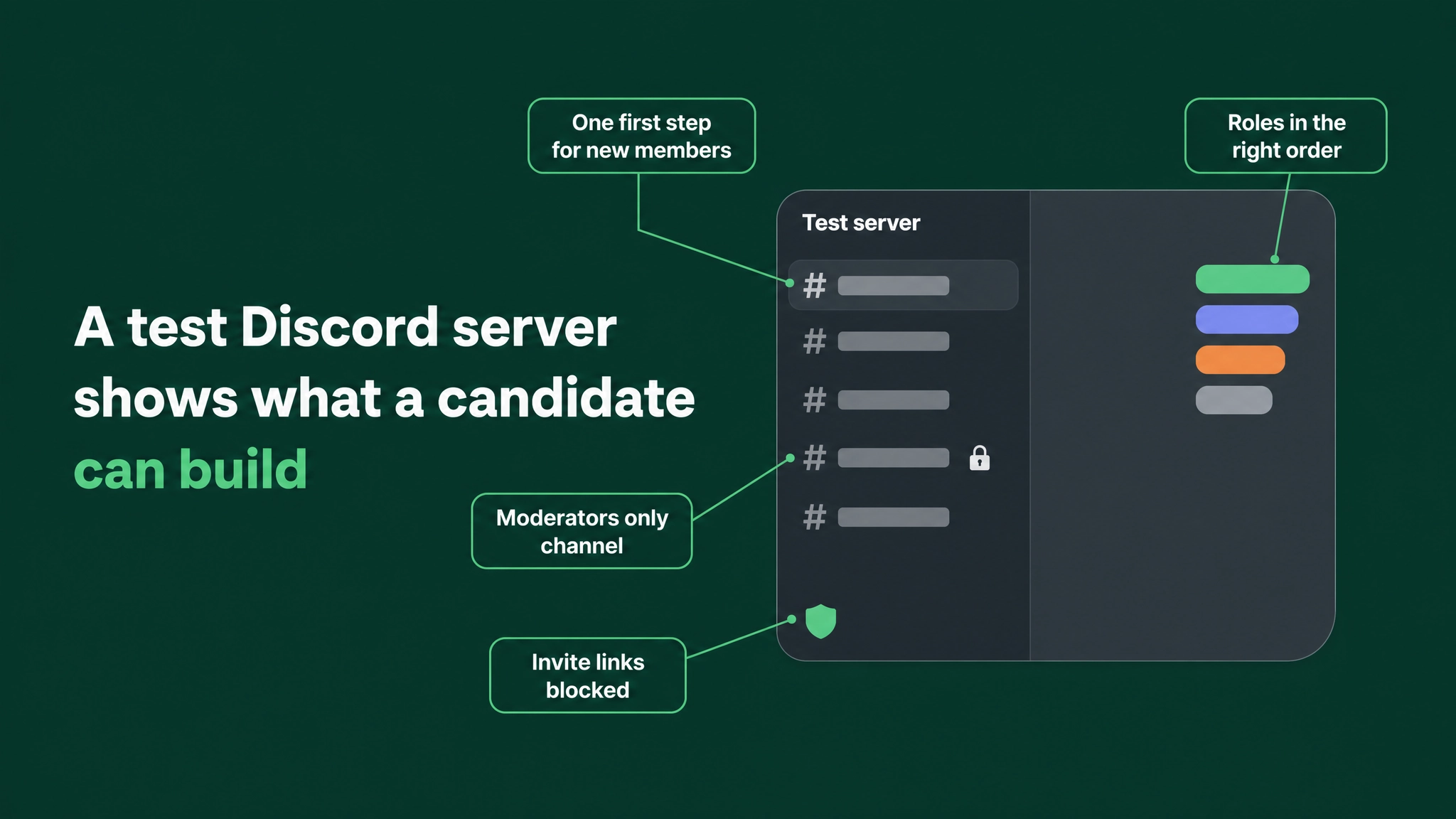
- Roles in the right order. Admin, Moderator, Member, New Member. Moderators can delete messages and time members out, and cannot change server settings.
- Two limited access channels. A moderators only channel that regular members cannot see, and an announcements channel that members can read and cannot post in.
- A new member welcome. A new arrival sees the rules and one clear first step, and receives the Member role after completing it.
- A scam link filter. Messages with Discord invite links are blocked for anyone without the Member role, moderators are exempt, and an alert goes to the moderators only channel.
- Show your checks. When finished, demonstrate how you confirmed each part works.
Onboarding has setup requirements of its own before Discord allows it to be enabled. Someone who has done this before handles them in the first few minutes. Someone who has not runs into them near the end, and that is useful evidence too.
The scoresheet. Copy this into your hiring notes and fill it in during the walkthrough.
LIVE BUILD SCORESHEET (0, 1 or 2 per line, 12 maximum)

Roles in the right order     2 = Moderator under Admin and over Member, no Administrator, bot roles above what they assign
                             0 = Moderator holds Administrator, or roles left in creation order

Limited access channels      2 = overrides on @everyone and the right roles, announcements readable and not postable
                             0 = everything visible, or hidden in a way nobody can explain

New member welcome           2 = Community on, onboarding question grants Member, one obvious first step
                             0 = a welcome message and no change to what a new member sees

Scam link filter             2 = AutoMod keyword rule on invite links, Moderator and Member exempt, alerts to mod channel
                             0 = no filter, or one that also blocks moderators

Checked own work             2 = used View Server As Role or a second account unprompted
                             0 = declared it done without checking

Walkthrough                  2 = explains each decision plainly, names one thing to change with more time
                             0 = cannot say why a setting is set that way

TOTAL: ____ / 12
The new member walk in. Join from your second account and look at what you built together. Try to open the moderators only channel. Try to post in announcements. Notice whether the first step is obvious. Paste an invite link before you have the Member role. Score each part on what you saw, even where it differs from what the candidate described.
Reading the result
Both halves score out of 12. For the build, use these bands:
| Build total | What to do |
|---|---|
| 10 to 12 | Can own the platform from the first day |
| 7 to 9 | Capable, with a senior person reviewing their setup through the first month |
| 6 or below | Do not hand over ownership of the server, however well the conversation went |
Where the interview total and the build total point different ways, go with the build. A candidate who talks well and builds poorly is likely to run your server the way they built the test one.
Warning signs while they work. Any one deserves a follow up question, and two or more usually decide it:
- Adds a bot before opening Server Settings
- Fills the server with channels so it looks busy
- Puts
Administratoron the Moderator role to save time - Builds in silence and cannot explain the result
- Never looks at the server from a member's point of view
The system around this step
This interview and test is one stage of a community staffing system. The other stages are the role spec written before applications open, the first 30 days of ramp, ongoing evaluation, the handover when someone moves on, and the escalation paths linking the community to the rest of the company. The screening stage is covered here in full, ready to use on your next hire. The others are separate pieces of work, and skipping any of them causes its own kind of trouble.
Every community manager gets tested eventually. The only choice is whether that happens in a throwaway server you delete afterwards, or in the one your members use every day. More at danieljeong.org.
Want a properly managed community?
Get Your Free Analysis →